


Le laboratoire de biologie et écologie végétale a organisé le vendredi 22 janvier 2016 à Ouagadougou, une journée de consultations nationales, dans l’optique de prendre en compte dans le programme de Wascal 2017-2020, des priorités en termes des besoins nationaux et en services sur les changements climatiques et l’utilisation adaptée des terres.
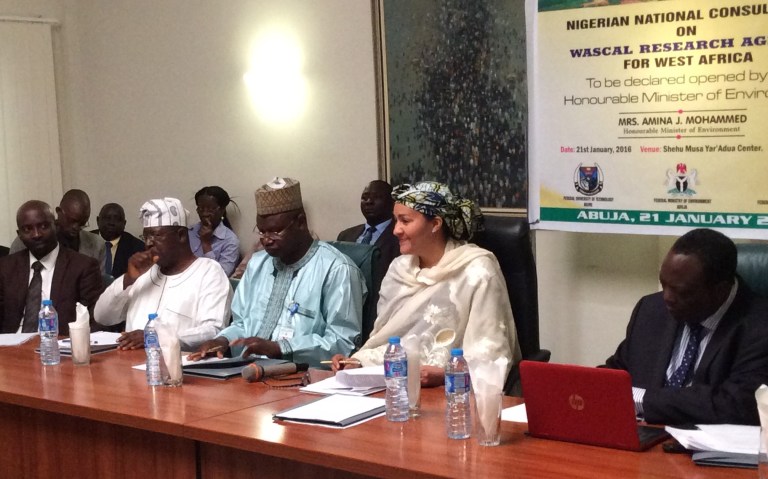
The West African Science Service Centre on Climate Change and Adapted Land Use (WASCAL) has been urged to key into Nigeria’s Intended Nationally Determined Contribution (INDC) as it begins the process of preparing a Research Agenda on Climate Change for the sub-region for the period spanning 2016 to 2020.
Environment Minister, Mrs Amina J. Mohammed, who made the disclosure on Thursday (January 21, 2016) in Abuja at the opening of a daylong stakeholders’ workshop on the WASCAL Research Agenda 2016, stressed that the agenda would not only bridge the gap between educational institutions and the government, but also with the industries.
While suggesting that outcome of the consultations should be communicated to her office for onward communication to Mr President, she disclosed that, as stated in the INDC, Nigeria aims to reduce emissions by 20% below BAU (business as usual) by 2030, rising to 45% with support from the international community.
“This has provided the needed national roadmap for sustainable development at all levels and in all key stakeholder constituencies,” the minister stated, even as she lamented that Nigeria is one of the most climate vulnerable countries in the world.
Her words: “By 2050, it could cost between six percent and 30 percent of its GDP. Nigerians are already profoundly aware of the damage caused by climate change impacts. The 2012 floods that killed several people and displaced more that 2.1 million are stack realities. These impacts are threatening the livelihoods of everyday Nigerians as well as aggravate regional conflicts such as depletion of the Lake Chad in the North East and the associated collapse of economic and institutional fabric, which has proved a breeding ground for terrorism.”
According to her, the current administration has come with a Change Agenda that is committed to an economic transformation which places inclusive, green growth at its heart.
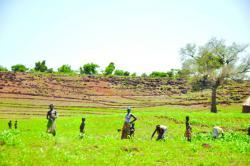
Pour relever le défi, il est nécessaire, pour le Centre Ouest-africain, de service scientifique sur le changement et l’utilisation adaptée des terres (Wascal), de développer des capacités scientifiques et organisationnelles, d’identifier les questions prioritaires liées au changement climatique, ainsi que les capacités et les besoins de recherche au plan national.
Lors de la conférence de Paris de 2015 sur le climat, la communauté internationale a pris des engagements forts pour réduire le réchauffement climatique.
L’Afrique de l’Ouest est l’une des régions du monde vulnérable aux impacts des changements climatiques.
Chaque pays devait y contribuer et adopter une politique adéquate d’utilisation des terres et le Burkina Faso, pays sahélien, est fortement préoccupé par ces problèmes.
D’où la tenue de cette journée de consultations nationales, qui a réuni tous les acteurs du domaine, le vendredi 22 janvier 2016, à Ouagadougou.
The Federal Government of Nigeria has announced plans to review all environmental laws, Acts that have to do with the nation’s environment.
The West African Science Service Centre on Climate Change and Adapted Land Use (WASCAL), a research centre of excellence at the College of Engineering of Kwame Nkrumah University of Science and Technology (KNUST) has held a day’s workshop on consultation on climate change
environewsnigeria.com – 18-01-16
Short:
The West Africa Science Service Centre on Climate Change and Adapted Land Use (WASCAL) is in the process of preparing a Research Agenda on Climate Change for the West African region for the period spanning 2016 to 2020.
Visit page

Please note: The call for application has been extended to January 22, 2016.
WASCAL (West African Science Service Center on Climate Change and Adapted Land Use) is a large-scale research-focused Climate Service Center designed to help tackle severe challenges posed by climate change and thereby enhance the resilience of human and environmental systems to climate change and increased variability. It does so by strengthening the research infrastructure and capacity in West Africa related to climate change and by pooling the expertise of ten West African countries and Germany. Through the Graduate Studies Program WASCAL’s Capacity Building Program helps educate the next generation of scientists to attain an intimate knowledge of different climate related issues in order to help the region develop suitable management strategies.
The WASCAL Graduate Studies Program supports four Master’s and six Doctoral Programs implemented at ten lead Universities across West African countries. WASCAL provides full scholarships to the Doctoral and Master’s students in all the ten lead Universities with comprehensive training and research support. Doctoral students may spend up to six months at a host institution in Germany. The language of instruction is English. English and French language training programs are provided for all graduate students. Graduate students have access to the research facilities set up through WASCAL funding and located at various watersheds in West Africa. German partner universities collaborate with the Doctoral and Master’s Programs in the areas of curriculum development, visiting professorships and co-supervision of graduate students.
The WASCAL Graduate Studies Program offers its students:
High quality research and education on climate change and its impact on human environmental systems.
Up to six months at a host institution in Germany (Doctoral Programs only!)
Interdisciplinary working approach
International lecturers and supervisors
English language classes
Scholarship and research budget, including a personal laptop computer
Doctoral Programs
West African Climate System
Federal University of Technology, Akure (FUTA), Nigeria
Apply now: Download call for applications and application form and the recommendation letter
Climate Change and Water Resources
Université d’Abomey-Calavi (UAC), Benin
Apply now: Download call for applications and application form
Climate Change Economics
Université Cheikh Anta Diop de Dakar (UCAD), Senegal
Apply now: Download call for applications and application form
Climate Change and Biodiversity
Université Felix Houphouet Boigny (formerly Université de Cocody‐Abidjan), Côte d‘Ivoire
Apply now: Download call for applications and application form
Climate Change and Land Use
Kwame Nkrumah University of Science and Technology (KNUST), Ghana
Apply now: Download call for applications and referee form and application form
Climate Change and Agriculture
L’Institut Polytechnique Rural de Formation et de Recherche Appliquée, (IPR-IFRA), Mali and University of Cape Coast, Ghana
Apply now: Download call for applications and application form
Time Frame
The time frame of the doctoral programs is three and a half years. During the first three months, students take English and/or French language classes and common courses at the language centers. During the next 6 months student participate in lectures at their Graduate Research Program and prepare their proposals. After their proposals have been approved by their supervisors, the students conduct their field research for 12 to 24 months. For the remaining period of time, students will write up their thesis and are offered to spend up to six months at a German host institution.
Requirements
Candidates applying for a Doctoral Program must have a Master’s degree in a relevant discipline in addition to a BSc degree (second class upper division).
Citizenship in one of the WASCAL member country (Bénin, Burkina Faso, Côte d’Ivoire, The Gambia, Ghana, Niger, Mali, Nigeria, Sénegal, Togo)
Five credits including Mathematics and English Language that are also equivalent to Francophone university grading system
Gender-balanced selection decision
Applicant should show proficiency in English Language.
Meet additional requirement of the lead university
Master’s Programs
Climate Change and Human Security
University of Lomé, Togo
Apply now: Download call for applications and application form
Climate Change and Education
University of The Gambia (UTG), The Gambia
Apply now: Download application form
Climate Change and Energy
Université Abdou Moumouni de Niamey (UAM), Niger
Apply now: Download call for applications and application form
Climate Change and Adapted Land Use
Federal University of Technology, Minna, Nigeria
Apply now: Download application form
Time Frame
The time frame for the Master’s programs is two years. During the first year students participate in the course program of their Graduate Research Program and work on their research outline. Research will be conducted during the second year within a period of six to nine months. Students finish the program with writing up their thesis during the last three to six month.
Requirements
Candidates applying for Master’s Program must have a minimum BSc degree (second class upper division) in a discipline relevant to the respective program.
Citizenship in one of the WASCAL member country (Bénin, Burkina Faso, Côte d’Ivoire, The Gambia, Ghana, Niger, Mali, Nigeria, Sénegal, Togo)
Five credits including Mathematics and English Language that are also equivalent to Francophone university grading system
Gender-balanced selection decision
Applicant should show proficiency in English Language.
Meet additional requirement of the lead university
Application Process
The application process is handled jointly by WASCAL and the individual Graduate Programs. Applications can be submitted online to any of the Graduate Studies Program for the 2015/2015 season until January 22, 2016. The details of the application process can be found at the respective programs pages (see linkes above). Shortlisted candidates will be contacted and invited for interviews by January 29, 2016.
More information on the Graduate Studies Program and on open applications can be found here or at the respective universities websites.
The West Africa Science Service Centre on Climate Change and Adapted Land Use (WASCAL) is in the process of preparing a Research Agenda on Climate Change for the West African region for the period spanning 2016 to 2020.
In the bid to properly fulfill its mission as a regional service centre on climate change and ensure that the needs of all West Africa countries are fully embedded in the research agenda, WASCAL will on Thursday (January 21, 2015) in Abuja hold a national stakeholders’ consultation.
The daylong dialogue, scheduled to hold at the Shehu Musa Yar’Adua Centre, will involve interactions among stakeholders on water resources, agriculture, environmental policy management, climate-science, the media and civil society. Environment Minister, Amina Mohammed, will formally open the roundtable.
ALSO READ: When Amina Mohammed visited impacted sites in Lagos
The dialogue is being organised by the Federal University of Technology, Akure (FUTA) in Ondo State, Federal University of Technology (FUT), Minna in Niger State, and Federal Ministry of Environment, Abuja.
Futa logoFutminna logo
The Federal University of Technology, Akure (FUTA) in Ondo State, Federal University of Technology (FUT), Minna in Niger State, and Federal Ministry of Environment, Abuja are joint organisers of the Dialogue
The Federal University of Technology, Akure (FUTA) in Ondo State, Federal University of Technology (FUT), Minna in Niger State, and Federal Ministry of Environment, Abuja are joint organisers of the Dialogue
“The stakeholders will brainstorm and come up with outcomes and strategies that would contribute to policy direction on climate change for sustainable national development,” said Professor Kehinde Ogunjobi, Director, WASCAL’s Graduate Studies Programme (GSP) in West Africa Climate System at FUTA in Ondo State.
ALSO READ: Fresh funds emerge for developing country climate action
According to him, WASCAL is a regional centre for capacity building in climate change across West Africa. He added that WASCAL is also designed to help tackle challenges of climate change thereby enhancing resilience of human and environmental system to climate change and variability. The WASCAL programme is being funded by the German Federal Ministry of Education and Research (BMBF).
His words: “It is a great privilege that Nigeria is the only West African country having two WASCAL programmes – one at the Federal University of Technology, Akure for Ph.D and at the Federal University of Technology, Minna for M.Sc degree.”
Countries under the WASCAL programme include Nigeria, Benin Republic, Niger Republic, Togo, Cote d’Ivoire, Senegal, Mali, Burkina Faso, The Gambia and Ghana.
ALSO READ: States urged to emulate Akwa Ibom State’s climate initiatives
The Vice-Chancellor of the Kwame Nkrumah University of Science and Technology (KNUST), Prof. William Otoo-Ellis, has reminded countries in Africa about the devastating impact of climate change on the socio-economic lives of their people.
He mentioned food insecurity following decline in crop yields of between five and 25 per cent and a projected revenue drop from 17 to 32 per cent as some of the effects of climate change that could occur on the continent.
Prof. Otoo-Ellis, who is a food scientist, further indicated that climate change would also have a serious impact on land use for both livestock and crop farming if the activities that precipitated the change were not stopped.
Ghana News Headlines
For latest news in Ghana, visit Graphic Online news headlines page Ghana news page
He was addressing the first stakeholder consultation workshop on climate change organised by the KNUST branch of the West Africa Science Service Centre on Climate Change and Adapted Land Use (WASCAL) in Kumasi last Wednesday.
The objectives of WASCAL include building the capacities of members to manage natural resources and developing and coordinating research agenda for the entire sub-region.
Currently, 10 WASCAL centres have been created in Africa where it is shaping policies to deal with the growing menace.
Attention
The vice-chancellor noted that in spite of education on the effects of climate change, the sector was not being given the necessary attention in the country’s sectoral development policies and strategies.
He described the situation as worrying, to the extent that if it was not checked, it could create a bleak future for member countries.
For instance, he said, the length of the maturing period for most crops could drop below 90 days in the Sahel region.
“Climate change poses a real challenge to natural and human systems in sub-Saharan Africa,” Prof. Otoo-Ellis emphasised.
Failure
A Nigerian scientist, Prof. Jerome Omotosho, said governments in the sub-region were partly to blame for the destruction of the environment because of price hikes on petroleum products such as liquified petroleum gas (LPG) and kerosene which were basic necessities.
He said such decisions made African governments hypocritical in that while they preached on the need to curb environmental degradation, their actions did not reflect their thoughts.
“The continuous increase in the prices of petroleum products will invariably compel our rural folks to go back to the bush and fell more trees. Our governments must have a change in policy direction and tackle climate change realistically,” he urged.
A five-member committee to represent Ghana at the regional consultative meeting is to be announced next month.

Governments across Africa have been asked not to underestimate the enormous threat posed to the continent’s development by climate change.
Professor Jerome Omotosho of the Department of Meteorology and Climate Science School, Federal University of Technology, Nigeria, said they needed to act with some urgency and commitment, to implement the various international protocols signed.
The inaction and lukewarm attitude would have to stop, he stated at a day’s workshop on climate change held at the Kwame Nkrumah University of Science and Technology (KNUST) in Kumasi.
It brought together environmentalists, agricultural research scientists, technocrats and graduate students.
“Climate data availability for climate change impact research”, “Overview of climate change dynamics in West Africa” and “Climate change activities in Ghana” were among topics treated.
Prof Omotosho called for substantial increase in budgetary allocations to tackle activities that were polluting and degrading the environment.
“We should invest in programmes relating to climate change in order to build a comprehensive regional preparedness agenda for progress”, he added.
Prof. Omotosho made reference to the noticeable shrink of the Lake Chad and the negative impact this was having on agricultural production, hydro-power generation and other socio-economic activities in Niger, Nigeria and Chad and said that must be a wake up call.
“Most people in this region whose livelihood is dependent on the water body are becoming more vulnerable.”
He noted that climate change was also badly affecting rain-fed agricultural production.
Prof William Otoo Ellis, Vice-Chancellor of the KNUST, said the goal was to build the capacity of the participants to spearhead the fight against the phenomenon.
Prof Samuel Odai, Director of the KNUST WASCAL Climate Change and Land Use Research Centre, said it was determined to provide expert training required to efficiently deal with climate change issues in the West African sub-region.
Source: GNA